Thursday, 25 July 2013

Sinn Féin LeadsThe Way


Correction: Dáil bar should close at the same time as licenced premises: Adams
Sinn Féin president, Gerry Adams TD, has confirmed that the Ceann Comhairle, at his request, has referred the opening hours of the Dáil bar to the Committee on Procedure and Privileges.
At present the Dáil bar remains open as long as the Dáil is sitting, but the Sinn Féin president said it should be subject to the same licencing laws as other bars”.
He raised the matter of the effects on staff of long hours, often unplanned and the rights of staff regarding working hours and conditions.
In his letter to the Ceann Comhairle, Gerry Adams TD said:
“I’m sure you may be further concerned with the declining standards of behaviour and the increased boisterous and raucous outbursts during late sittings, which I believe are linked to the longer opening hours.”
Deputy Adams also asks the Ceann Comhairle to clarify if the Dáil bars do, in fact, have a licence, saying he had been told they do not. “If this is the case, could you let me know how this is so?” he added.

Wednesday, 24 July 2013

Labour Party/Fine Gael, Tax,Tax,Tax the Poor & Protect the Rich


July 24th, 2013 - Trevor O Clochartaigh
Sinn Féin Senator Trevor O’Clochartaigh described the admission by Minister Hogan today that the government proposes to start charging for water from October 2014 as cynical and unfair.

Senator O’Clochartaigh said:

“Minister Hogan admitted today that the water charges will commence in October 2014. Families will receive the bills in early 2015.

“In a cynical move the government is holding off until after next year’s local elections before anyone receives a bill. Fine Gael and the Labour Party know that to issue the bills before May would certainly mean a loss of council seats. The current proposal to charge households for water was dreamt up by Fianna Fáil but brought to life by Fine Gael and Labour.

“Water charges are wrong. To charge people for the water they drink is unacceptable. The reality is struggling families will be hit with yet another bill. In Denmark, with a population similar to our own, water metering is in place and in 2007 the average cost was €715 per household.

“The government spins a myth that we do not pay for our water.  We pay for our water service in our taxes. Water charges will mean the public pay three times for their water.

“Firstly in their general taxes, secondly through this new charge and, finally, they will pay through the National Pension Reserve Fund, which is being used to fund the installation of water meters. Local Authority Professional Officers have given estimates of €1.2 billion to cover the cost of the installation. It is ordinary householders who will be footing the bill.

“Sinn Féin is committed to opposing the introduction of domestic water charges. We will continue to work with trade unions and residents in our opposition to this process.”

Sinn Féin Mountmellick - Working For The Community

Tuesday, 23 July 2013

Old Bog Road Walk & Talk


Inaugural Old Bog Road Walk & Talk Mountmellick


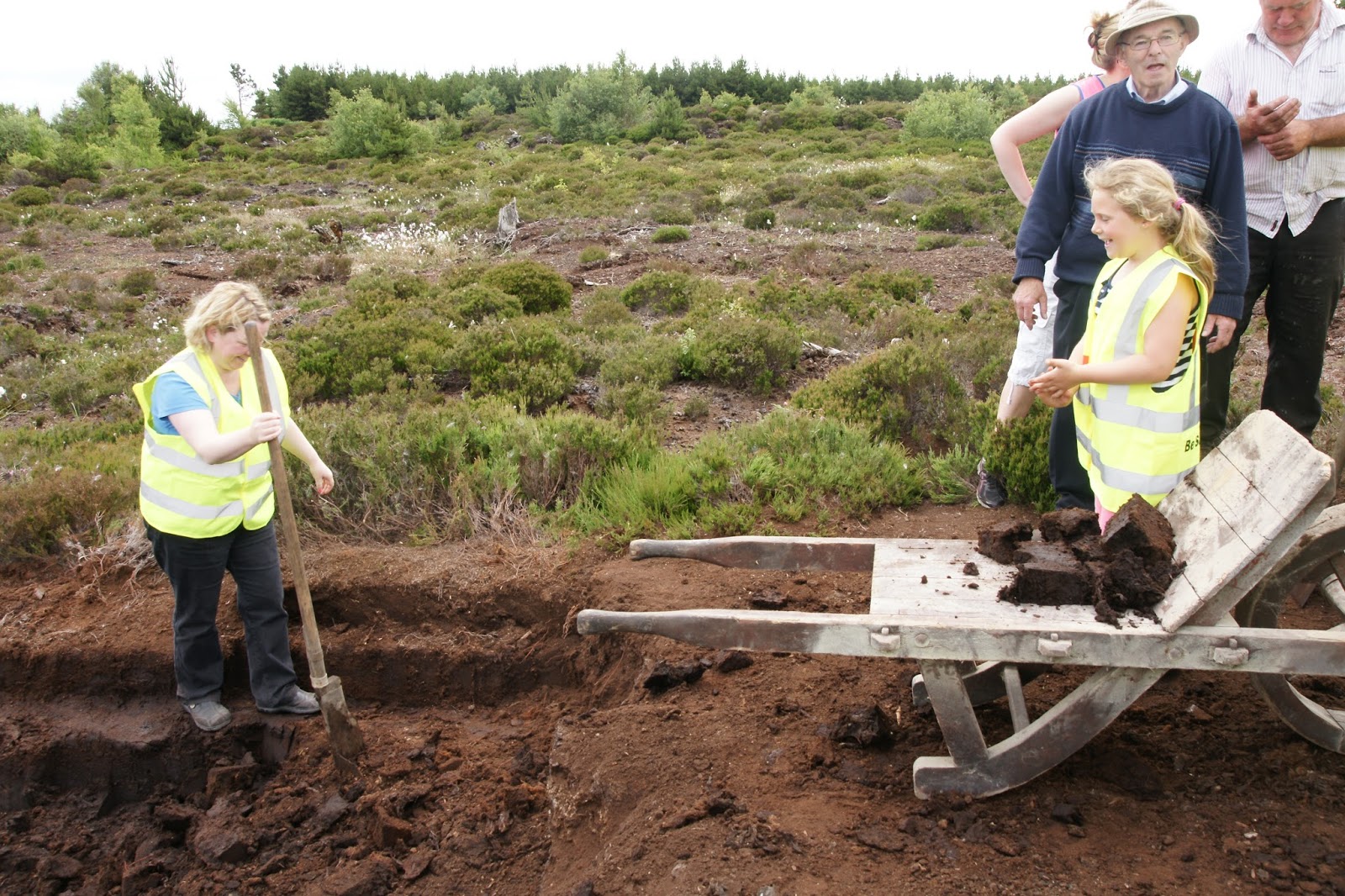
Thirty walkers took part in a very enjoyable inaugural old Bog Road Walk & Talk on Sunday July 7th in Mountmellick. The walk was organized by the Willie Brock Sinn Féin Cumann. Walk leader was Dick Fitzpatrick.


As the walk proceeded Dick revealed some interesting local history. The Quaker Burial ground on the Bay road. Examples of large cast iron pipes from the iron foundry which once flourished in Mountmellick. Which are still used as gateposts, onto farmers lands.
How the Bay road got its name. "The rivers Barrow, Owenass and Triogue flooded the area for months at a time".
We visited the site of Deputy Brian Stanley's old homestead in Lower Forest. Brian revealed that his Fathers job with Bord na Mona entailed his family living there in the early 1950’s.

The walk proceeded to Forest Bog where most people tried their hand at cutting turf by Slane and spreading it out to dry by Bog Barrow. Dick explained the difference between the local slane and one from Connemara.
Walkers marveled at the beauty of the area and the plans of Bord na Mona to develop an Eco Park and Water Reservoir in the area to supply Dublin.
It was felt that the area had enormous potential for the development of walks, for the benefit of local People and tourism.

The Willie Brock Cumann hopes to make this walk an annual event.


Sinn Féin Mountmellick - Serving The Community


Monday, 22 July 2013

My Phone /My Friend


NSA locates cell phones even when they are turned off
RT
Published time: July 22, 2013 20:33
Never mind the non-stop collection of metadata and other sneaky surveillance tools being implemented by the NSA: a new report has revealed that the National Security Agency’s spy powers allow the government to grab location data on just about anyone.
In an article published by the Washington Post over the weekend, journalist Dana Priest detailed how one of the most secretive agencies administered by the United States government has expanded drastically in the decade-plus since the terrorist attacks of September 11, 2001. An increased demand for intelligence encouraged the development and implementation of surveillance tactics previous confined to the pages of science fiction, she wrote, and those tools today rival even what has already been unearthed by the NSA’s undercover operations.
Lacking a strong informant network to provide details about al-Qaeda, US intelligence and the military turned to the NSA’s technology to fill the void,” Priest wrote.
According to Priest, policies enacted in a post-9/11 intelligence community involved a pivotal role played by the National Geospatial-Intelligence Agency, a Department of Defense office that was created to collect battlefield intelligence using the most sophisticated of means available. In the wake of 9/11, that involved being able to pinpoint the location of a suspected adversary using only a cell phone number, and agents with that kind of access quickly were on-demand outside of the walls of the NGIA and NSA.
In one incident reported by Priest, a Navy SEAL working within a makeshift Central Intelligence Agency operations center in one part of the US called up an agent in the basement of the NSA’s base in Augusta, Georgia and insisted a team of geolocation specialists identify the exact location of an insurgent in Afghanistan using only the suspect’s telephone number.
Once all parties were properly coordinated, Priest wrote “they aimed the NSA’s many sensors toward individual targets while tactical units aimed their weaponry against them.”
Priest went on to call that moment and others like it revolutionary with regards to what was to come for the NSA. The intelligence tools once used to track and spy on the leaders of competing countries and adversaries around the world had been deployed to target a single suspected terrorists 8,000 miles away using the resources utilized by an ever-expanding agency still only in its infancy.
Thanks to a bevy of whistleblowers who exposed the agency’s use of domestic surveillance years before the name Edward Snowden was known, today it’s common knowledge that the communications of American citizens can be inadvertently collected by the NSA. Leaked documents attributed to Snowden during the last several weeks have shined further light on how the Foreign Intelligence Surveillance Act, the PATRIOT Act and an array of tactics take conversations sent over telephone wires, fiber optic cables and Wi-Fi signals and send them to Uncle Sam. In her article for the Post, though, Priest wrote that these tools are coupled with military agencies at times to create a quick and coordinated action that often ends in the execution of an alleged enemy.
By September 2004, a new NSA technique enabled the agency to find cellphones even when they were turned off,” Priest wrote. The tactic was called “The Find,” and reportedly it gave the Joint Special Operations Command the tools to track down members of al-Qaeda and other extremist group and then order a hit. Combining it with another new system, the Real Time Regional Gateway, both intelligence and military officers could access any type of surveillance in a given region under which a target could be tracked.
We Track ’Em, You Whack ’Em,” was a motto that the Augusta, Georgia geolocation agents quickly adopted, Priest wrote.
But 12 years after the September 11 attack — and more than three since al-Qaeda leader Osama bin Laden was executed thanks to tactics employed by the NSA, CIA and others — these operations have not been scaled back. Instead, rather, the NSA has expanded around the globe and is currently in the midst of building what will be one of the largest intelligence facilities in America.
That structure, a million-square-foot data storage facility in Bluffdale, Utah, when all is said and done will collect domestic intelligence that one former NSA worker said isn’t necessarily relevant to anything.
Bill Binney, a former NSA agent that resigned after 9/11 with more than three decades of experience under his belt, said the government is collecting data before even figuring out what to do with it.
"They would have plenty of space with five zettabytes to store at least something on the order of 100 years’ worth of the worldwide communications, phones and emails and stuff like that," Binney told Wired last year, "and then have plenty of space left over to do any kind of parallel processing to try to break codes."
It’s everything — phones, emails, twitter, any kind of digital communications that they’ve had. I think it’s into banking as well, but I don’t know that for sure. I do believe they’re doing it,” he added to Libertas Institute in an interview last month. “My estimate is that there’s a little over 280 million Americans in the database, several times because one person can have a work phone, home phone, mobile phone, online banking, multiple email addresses. Two-hundred-and-eighty million people are in there at least, and the ones that aren’t are babies in cribs, people in hospice, others not doing anything electronic. Each person is in there between several hundred and several thousand times. It’s aggregated data over a now 12 year period.”
Meanwhile, the NSA defends the construction of both foreign and domestic facilities, citing to Priest the need to stay one-step ahead of the adversary.
The notion of constant, unchecked, or senseless growth is a myth,” the NSA said in a statement to the Post.


Sinn Féin Mountmellick - Serving The Community

Thursday, 18 July 2013

Austerity Targets Small Rural Schools


Proposed cuts to small schools unacceptable - Deputy Jonathan O’Brien
Responding to comments made this week by education Minister Ruairí Quinn that the pupil teacher ratio (PTR) in small schools would likely be increased in order to help meet the €44 million cuts to this year's education budget.
Sinn Féin Cork North Central TD Jonathan O’Brien said:
“Minister Quinn has made clear his intention again to target small schools by increasing their pupil teacher ratio (PTR) and this very regressive measure will come as a serious blow to rural communities.
“Increasing the PTR in small schools will make many of these schools unviable and force their closure

“The rationale behind these cuts is the continual implementation of the government’s austerity agenda and their determination to take a further €44 million out of the education budget. 
“No consideration is being made to develop a small schools policy similar to what is in place in the Six Counties where the focus is on safeguarding strategically important schools and implementing policies that are strategically driven to deliver sustainable, high quality education.
“The decision to increase in the PTR is being taken at time when Irish classrooms are amongst the highest in Europe and the continual slashing of the Irish education budget has now reached unsustainable levels. 
“This has been highlighted by the Education at a Glance 2013 Report by the Organisation for Economic Co-operation and Development (OECD) which ranked the 26 Counties in 29th place out of 32 OECD countries in terms of the percentage of public expenditure that is spend on our education system.”

Sinn Féin Mountmellick - Serving The Community